
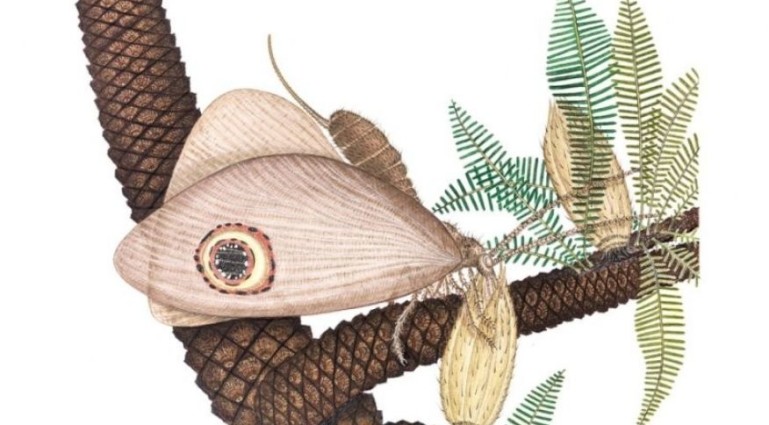
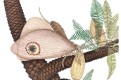
Scientists have discovered an insect that went extinct for more than 120 million years and featured many of the traits associated with modern butterflies including markings on the wing called eye spots.
Known as Kalligrammatid lacewings, paleobotanists for the past century have known they lived in Eurasia during the Mesozoic. But it’s taken recent discoveries of well-preserved fossils from two sites in northeastern China to demonstrate how similar they were to modern butterflies. Thanks to extensive lakes that limited oxygen exposure in these areas during mid-Jurassic through early Cretaceous time, paleontologists have been able to recover exquisitely preserved fossils that retain much of their original structure.
“Poor preservation of lacewing fossils had always stymied attempts to conduct a detailed morphological and ecological examination of the kalligrammatid,” Indiana University’s David Dilcher, who was part of the team that made the discovery published in the journal Proceedings of the Royal Society B, said in a statement. “Upon examining these new fossils, however, we’ve unraveled a surprisingly wide array of physical and ecological similarities between the fossil species and modern butterflies, which shared a common ancestor 320 million years ago.”
Dilcher, who also discovered the first flower last year, found that this insect from the Jurassic period survived in a manner similar their modern sister insects by visiting plants with “flower-like” reproductive organs producing nectar and pollen. They probably used their long tongues to probe nectar deep within the plant and also possessed hairy legs that allowed for carrying pollen from the male flower-like reproductive organs of one plant to the flower-like female reproductive organs of another.
Eventually, this system of pollination by long-tongued lacewings traveling between plants with exposed reproductive parts – called gymnosperms – gave way to more familiar system of insect pollinators and modern flowers, or angiosperms, in which the reproductive parts of the plants are contained with a protective seed.
This butterfly-like behavior is striking considering that modern butterflies didn’t appear on Earth for another 50 million years.



Kylie Jenner becomes world’s youngest billionaire
Kylie Jenner has become the world's youngest billionaire, according to the latest Forbes bi...

Bafta: Queen director Singer suspended from nomination
Bohemian Rhapsody director Bryan Singer has been removed from his film's Bafta Awards nomi...

Officials could negotiate with terrorists to free kidnapped Nigerian s...
ABUJA, Nigeria – Nigeria's government still is open to negotiating with Boko Haram extrem...


Rare painting by Dutch Renaissance artist Hieronymus Bosch found in Kansas
A rare 500-year-old work by Dutch Renaissance artist Hieronymus Bosch, previously attributed to the painterâ...
Meat on famed 1950s Explorer Club gala menu was actually sea turtle
The meat eaten at a lavish New York City Explorers Club dinner in 1951 – which at one point was thought to...
Daddy Longlegs fossil keeps erection for 99 million years
If you think an erection lasting more than 4 hours is a problem, try one lasting more than 99 million years....
Rising temperatures could be bad news for male loggerhead turtles
Rising global temperatures may be blamed for fewer male loggerhead turtles being born, which could lead to a...

Teen hockey game canceled after Zamboni driver destroys rink

Toll rises to 44 dead in Japan earthquake; Toyota Motors suspends operations in 16 assembly plants















Comments (0 )