
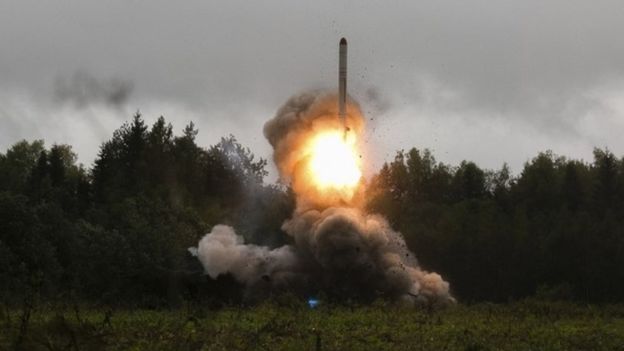
Russia has suspended its involvement in the Cold War-era Intermediate-Range Nuclear Forces Treaty (INF) following a similar decision by the US.
President Vladimir Putin said Russia would start developing new missiles.
On Friday, the US, which has long accused Russia of violating the treaty, formally announced it was suspending its obligations under the agreement.
Signed in 1987 by the US and USSR, it banned the use of short and medium-range missiles by both countries.
“Our American partners announced that they are suspending their participation in the treaty, and we are suspending it too,” Mr Putin said on Saturday.
“All of our proposals in this sphere, as before, remain on the table, the doors for talks are open,” he added.
Earlier on Saturday, Nato Secretary General Jens Stoltenberg told the BBC: “All [European] allies agree with the United States because Russia has violated the treaty for several years. They are deploying more and more of the new nuclear capable missiles in Europe.”
He also said the six-month period the US had given Russia to return to full compliance should be taken advantage of.
Russia has denied violating the INF accord.
The Americans say they have evidence that a new Russian missile falls within the 500-5,500km (310-3,400 miles) range banned by the treaty.
Some US officials have said that a number of 9M729 missiles – known to Nato as SSC-8 – have already been deployed.
The evidence has been put to Washington’s Nato allies and they have all backed the US case.
In December, the Trump administration gave Russia 60 days to return to compliance or the US would also cease to honour its terms.
Besides denying breaking the INF treaty, Moscow says that US anti-ballistic missile interceptors being deployed in Eastern Europe could potentially violate the terms of the agreement.
At Saturday’s meeting with his foreign and defence ministers, President Putin said work would begin on creating new weapons.
These, he said, included a land-based version of Russia’s sea-launched Kalibr cruise missile, and new hypersonic weapons which can travel more than five times the speed of sound.
But Mr Putin said Moscow would not get dragged into an expensive arms race, and would not deploy short- and medium-range missiles unless US weapons were deployed there first.
Such an arms race would be a major concern for European countries.
“These new missiles are mobile, hard to detect, nuclear capable, can reach European cities and they have hardly any warning time at all so they reduce the threshold for any potential use of nuclear weapons in a conflict,” Nato’s Jens Stoltenberg told the BBC.



Bafta: Queen director Singer suspended from nomination
Bohemian Rhapsody director Bryan Singer has been removed from his film's Bafta Awards nomi...
Officials could negotiate with terrorists to free kidnapped Nigerian s...
ABUJA, Nigeria – Nigeria's government still is open to negotiating with Boko Haram extrem...
Kremlin warns US plan to quit nuclear pact is ‘dangerous’
Independent The Kremlin said yesterday that a landmark nuclear arms treaty that Washin...


US issues treatment guidelines for infants exposed to Zika
















Comments (0 )