
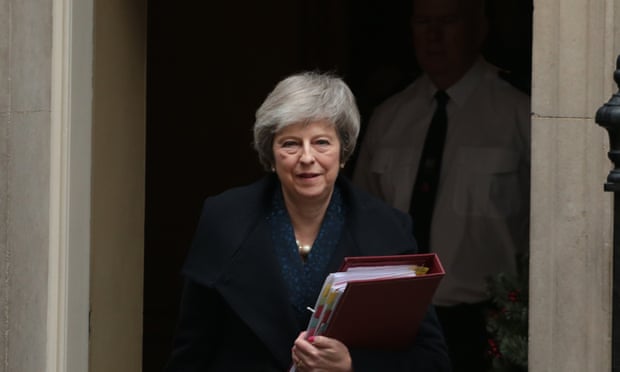
Theresa May has won the backing of her party to stay on as prime minister – but more than a third of Conservative MPs voted against her, underscoring the uphill battle she faces in getting her Brexit deal through parliament.
Tory MPs rejected a no-confidence motion in the embattled prime minister’s leadership by 200 votes to 117 on Wednesday night, after a swift contest that exposed the bitter split in her party over Brexit.
May emerged from 10 Downing Street after the result to say her party had a “renewed mission”, of “delivering the Brexit that people voted for, bringing the country back together and building a Britain that truly works for everyone”, and to urge MPs from all parties to cooperate to deliver Brexit in the national interest.
But Brexiters hailed the 117 votes cast against her as a clear indication that her Brexit deal is deeply unpopular on her own side of the House of Commons.
A loud cheer erupted among Tory MPs as the chair of the backbench 1922 Committee, Sir Graham Brady, announced: “The result of the ballot held this evening is that the parliamentary party does have confidence in Theresa May” – and confirmed that she could not now be challenged for another year.
May will fly to Brussels on Thursday to appeal to her fellow EU leaders to offer Britain what she told MPs must be a “legally binding” commitment that the Irish backstop will be temporary.
The Labour leader, Jeremy Corbyn, said: “Tonight’s vote makes no difference to the lives of our people,” urging the prime minister to “bring her dismal deal back to the House of Commons next week so parliament can take back control”.
That call was echoed by the European Research Group (ERG) of pro-Brexit Tory MPs, which had demanded the no-confidence vote. An ERG source said the group could not support her deal, and she should “bring it back to parliament without delay”.
May had appealed to her Conservative colleagues to let her press ahead with Brexit at a packed meeting in a Westminster committee room on Wednesday evening – and pledged to step down before 2022.
Some MPs banged the tables in acclamation, but others pressed her on when she would resign. One trenchant critic, the North East Derbyshire MP, Lee Rowley, told her: “Stamina is not a strategy.”
The chancellor, Philip Hammond, had earlier welcomed the no-confidence vote, saying it would “flush out the extremists”.
MPs present at the tense meeting of the Tory party said May told them that “in my heart, I would like to fight the next general election” – to make up for the Conservatives’ poor performance in 2017 – but signalled that she would step down before 2022.
The Conservative party deputy chair, James Cleverly, a May loyalist, emerged from the 1922 Committee meeting and said: “She recognises a lot of people are not comfortable with her leading us into a future general election.”
However, the prime minister avoided offering a specific date at which she would resign.
She also offered a sobering message about the challenges the government faces in getting its Brexit deal through parliament, with shifting groups of MPs advocating a series of incompatible options – from a second referendum to no deal.
By promising to step down before 2022, the prime minister hoped to peel off MPs who fear she would be an electoral liability, but she also risked further undermining her already fragile authority.
The ERG chair, Jacob Rees-Mogg, who had been calling for May to face a vote of no confidence for several weeks, said she had “hedged her bets”.
“She said that in her heart she would like to fight the 2022 election, but that she recognised the party did not want her to, and therefore it was not her intention to,” he said. “But the word ‘intention’ is a classic politician’s word, because intentions can change.”
After the result, fellow Eurosceptic Mark Francois said: “We all need to go and get a decent night’s sleep and look at it afresh in the morning. But if you’re a PM and a third of your MPs vote against you, that is very bad news.”
The confidence vote marked the culmination of a tumultuous 72 hours, after the prime minister outraged many backbenchers by announcing at the last minute that she would cancel the “meaningful vote” on her Brexit deal.
She spent Tuesday criss-crossing Europe on a whistle-stop diplomatic tour, aimed at seeking fresh reassurances from her EU counterparts on the Irish backstop.
But while she was meeting EU leaders in The Hague, Berlin and Brussels, MPs at home, exasperated at what they regarded as her lack of leadership, were firing off letters of no confidence.
Brady informed May late on Tuesday night that she would face a no-confidence vote – and announced on Wednesday morning that it would be held less than 12 hours later.
The prime minister spoke to the DUP leader, Arlene Foster, and the party’s Brexit spokesman, Nigel Dodds, on Wednesday afternoon. Foster later said: “We emphasised that tinkering around the edges would not work. We were not seeking assurances or promises. We wanted fundamental legal text changes.”
The solicitor general, Robert Buckland, also speaking outside the 1922 Committee meeting, said: “The party has to be prepared to give her the space to go back to the EU. And today’s vote flies in the face of giving her the chance to finish the job. The ship is nearly into port, why drop the pilot now? There is a very wide range of views, she is doing her best to span the majority of colleagues. People referenced her stamina, frankly.”
After the party meeting, MPs filed in one by one to cast their votes in a secret ballot.
Privately, some senior Brexiters concede that they had hoped May would respond to news that at least 48 of her colleagues had lost confidence in her by resigning.
But instead, she gave a defiant speech outside 10 Downing Street on Wednesday morning, saying she would contest the vote “with everything I’ve got”.
Cabinet ministers, including some widely tipped as potential successors to the prime minister, subsequently took to the airwaves in a concerted show of support.
They echoed the prime minister’s message that airing their divisions in public would undermine voters’ trust in the Tory party – and it would be difficult for any new leader to change the course of Brexit before the 29 March date on which Britain is due to leave the EU.
As her colleagues considered whether to support her, May clashed with Jeremy Corbyn across the Commons dispatch box at prime minister’s questions.
The Labour leader angrily accused her of treating parliament in a “totally and utterly unacceptable” way, and pressed her to say when she would stage the delayed “meaningful vote” on her Brexit deal.
To jeers from Conservative MPs, the SNP’s Westminster leader, Ian Blackford, called on the prime minister to resign. “We were promised ‘strong and stable’. We were promised a vote on the Brexit deal. But this prime minister cannot even do her own job because of the Tory civil war,” he said.



Bafta: Queen director Singer suspended from nomination
Bohemian Rhapsody director Bryan Singer has been removed from his film's Bafta Awards nomi...

Officials could negotiate with terrorists to free kidnapped Nigerian s...
ABUJA, Nigeria – Nigeria's government still is open to negotiating with Boko Haram extrem...

Kremlin warns US plan to quit nuclear pact is ‘dangerous’
Independent The Kremlin said yesterday that a landmark nuclear arms treaty that Washin...


Trump plots big TV ad blitz that could change campaign landscape

Mother nature not making it easy for millions of holiday travelers
















Comments (0 )